How to Start a D2C Fashion Brand in India
Start with a focused collection, a catalogue that answers buying questions, and a small launch loop you can learn from before scaling your D2C fashion brand.
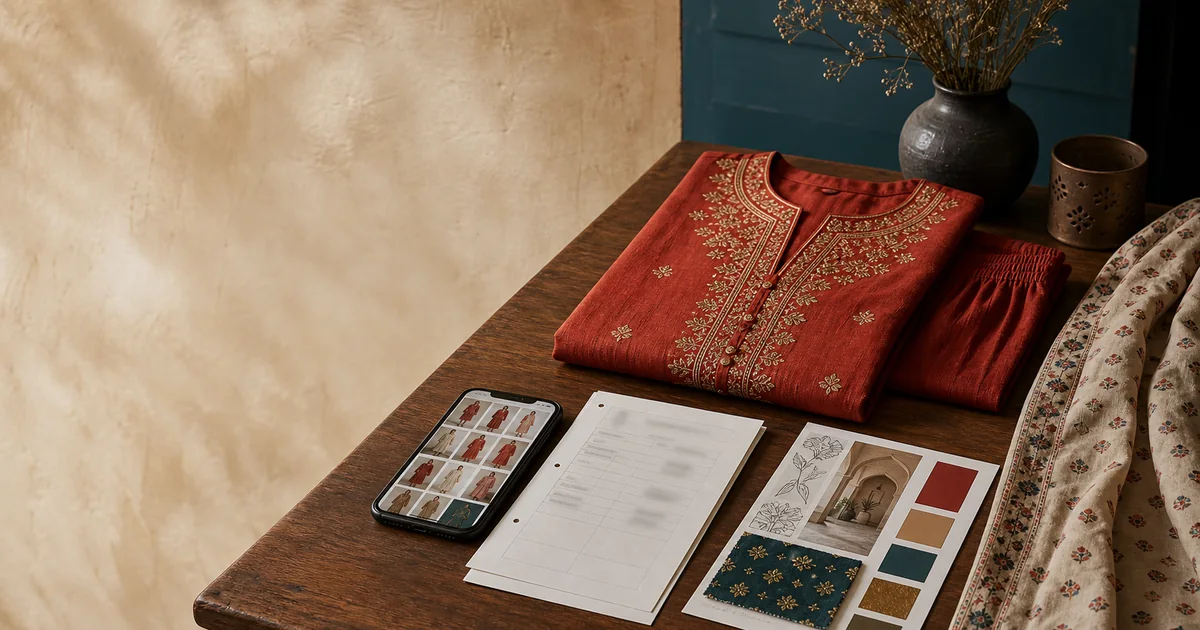
To start a D2C fashion brand in India, do not begin by trying to look like a finished brand. Begin by proving that one tightly defined collection solves a real buying job for a specific customer. Then make the product easy to trust online, launch it through a small set of channels, and use what you learn to decide the next drop. Your first goal is not a large catalogue or a perfect campaign. It is a repeatable system for turning a garment into a saleable product story.
That order matters in apparel. A buyer cannot feel the fabric, inspect the finishing, or see how a silhouette moves from a product page. Your collection, catalogue, operations, and creative all have to carry that trust. This guide is a practical way to build the first version without treating every decision as permanent.
Start with one customer, one occasion, and one collection
“Women’s ethnic wear” is a category, not a launch plan. A useful first collection gives one person a reason to choose it for a particular moment: breathable work kurtas for commuters, occasion sets for wedding guests, or easy festive co-ords for family gatherings. The more specific the first job, the easier it is to decide on fabrics, price bands, sizing, imagery, and the language on the product page.
Write a one-page collection brief before placing a large production order. It should answer:
- Who is this for, and what does she need the garment to do?
- Where will she discover it: Instagram, WhatsApp, a marketplace, a Shopify store, or a mix?
- What makes this collection recognisable at a glance?
- Which details could stop a purchase if they are not shown clearly: fit, lining, embroidery, colour, pockets, sleeve length, or fabric weight?
- What is the smallest assortment that lets a customer understand the point of view?
For example, a founder launching an everyday kurta line may start with three silhouettes in two colours, rather than thirty unrelated SKUs. That is enough to test the silhouette, the price range, and the product story without creating a catalogue that is expensive to photograph, stock, and explain.
A focused collection is not a smaller ambition. It is a faster route to evidence.
Prove the product before building the whole brand
The riskiest early assumption is usually not the logo or the website. It is whether the garment holds up against the promise you are making. Wear-test samples, check size consistency, inspect the finishing after a wash where relevant, and have people who resemble the intended customer react to the product and its price.
Ask practical questions rather than fishing for compliments. Would they wear this to the occasion you named? What detail makes the price feel fair or unfair? What would they need to see online before ordering? If the same uncertainty appears in several conversations, it belongs in the product specification or the catalogue.
This is also the time to settle your delivery and returns reality. A generous-looking returns line is not useful if the operation cannot process it. Shopify’s India guidance treats store setup, payments, delivery options, and customer communication as connected launch work, not as separate afterthoughts. Its fashion-store guide is a helpful platform-level checklist; your own policy still needs to match your margins and fulfilment capacity.
If you are formalising an eligible MSME, use the official Udyam Registration portal rather than a paid intermediary. Registration and tax requirements depend on your setup and circumstances, so get advice from a qualified professional before treating any online guide as legal or tax advice.
Make the catalogue do the selling
An apparel catalogue is a set of answers to the buyer’s silent questions. Is that red truly this red? Is the kurta straight, A-line, or flared? Does the zari sit flat? Is there a lining? Where does the hem land? A generic pretty image can attract attention, but it rarely settles those questions.
For every hero SKU, prepare a minimum product evidence set:
| Buying question | What to show or state |
|---|---|
| What is it? | A clean full-garment front view and a precise product name |
| How does it fit? | On-body view, size guide, model size, and silhouette notes |
| What am I paying for? | Close crops of embroidery, weave, trim, and construction |
| What arrives? | Fabric composition, care, lining, set contents, and colour note |
| Can I trust the colour and back? | Back view plus consistent colour treatment across product images |
Do not make one image attempt to do every job. A marketplace thumbnail, Shopify PDP hero, Instagram Reel cover, and paid-social ad have different crops and different amounts of visual context. Plan these placements before the shoot or render, so the same garment reference can produce a useful system rather than a folder of near-duplicates.
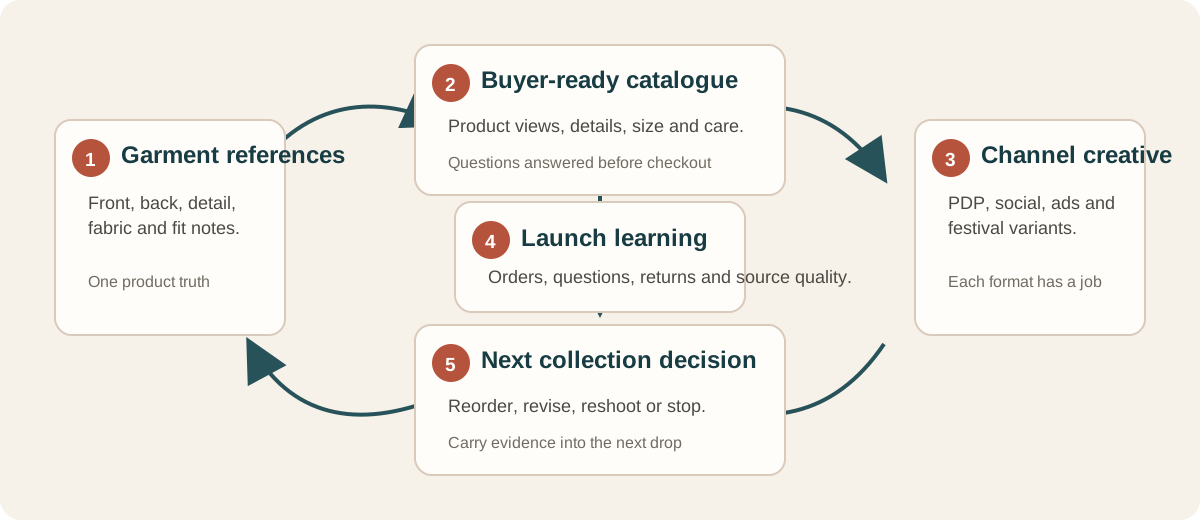
The first collection should produce a feedback loop, not just a one-time launch.
Set up the minimum viable commerce and operations stack
Choose a stack that lets you sell, fulfil, support, and learn without creating a second operations job. For many early D2C brands, that means one owned storefront, one or two discovery channels, a payment setup, a shipping partner, and a simple way to track stock and customer questions. The exact vendors are less important than having clear owners for each customer hand-off.
Before you open the store, test the path a customer will take:
- Find a product from a phone.
- Understand its size, fabric, and delivery promise.
- Complete payment or COD selection.
- Receive an order confirmation and a useful support contact.
- Track delivery and, if needed, start a return or exchange.
Run this as a real test order. It exposes the gaps that a homepage review cannot: unclear sizing, an unexpected shipping charge, broken tracking, or a support message that has no owner. Keep the first version deliberately plain if necessary. A fast, dependable experience earns more than a highly styled store that leaves basic questions unanswered.
Plan a launch calendar around actual buying moments
Fashion demand is rarely evenly spread across the year. Build the first launch around the buying moment your collection serves, then leave room for production, photography, dispatch, and customer questions before the moment arrives. In India, that may mean planning backwards from a festival, wedding season, college reopening, or a local climate shift—not merely from a social-media content calendar.
Use a simple three-part calendar:
- Preparation: lock samples, product information, image requirements, inventory, and support scripts.
- Release: publish the product story, introduce the collection across your chosen channels, and make the purchase path easy to check on mobile.
- Learning window: collect repeated questions, size issues, top-viewed SKUs, conversion by source, and return reasons before changing the next drop.
Avoid declaring victory from likes alone. A Reel may be useful if it produces qualified product-page visits; a quiet product may be valuable if it converts well once shoppers reach it. Decide in advance which signals will tell you to reorder, reshoot, revise, or stop.
Create a small creative system, not a one-off shoot
One large shoot can produce beautiful assets, but it can also leave a founder stranded whenever a new colourway, customer question, or festival requires a fresh asset. Build a creative system around reusable inputs: garment reference photos, an approved product-detail checklist, brand colours, model and backdrop direction, channel dimensions, and a way to record what performed.
This is where RoopTantra can shorten the production work. From front and back garment references, Karigar chat can create and revise product imagery, campaign assets, and channel-specific variants while keeping the garment reference central to the request. It can also connect creative work to the wider workflow of campaign planning and performance review. Treat generated outputs as creative production that still needs your approval for garment accuracy, product claims, and brand fit. When your evidence set is ready, start a RoopTantra workspace and seed Karigar with the collection brief rather than rebuilding it in another tool.
The test is simple: when a buyer asks for a back view or a closer look at embroidery, can your team produce the right answer quickly without recreating the entire brief? If not, the creative process is a bottleneck, not yet a system.
Run the first launch as an experiment
Set a learning period for the first collection—long enough to observe orders and questions, short enough to make decisions while the signal is still fresh. Record a small scorecard by SKU:
- Product-page visits and add-to-cart rate
- Orders and conversion rate by acquisition source
- Average order value and discount dependence
- Repeated pre-purchase questions
- Exchanges, returns, and their stated reasons
- Creative variation used for the visit or order, where you can track it
You do not need perfect attribution on day one. You do need a habit of reconciling the stories your channels tell you with actual orders, costs, and customer feedback. Look for patterns you can act on: a product that gets attention but raises the same sizing question; a detail crop that sends more qualified traffic; or a strong silhouette whose colour options are confusing.
The second collection should inherit those lessons. That is the advantage D2C gives an apparel operator: the product, catalogue, creative, and customer response can inform one another quickly when the system is designed to remember.
Common launch mistakes
The first is launching too broad. More SKUs increase photo work, stock risk, copywriting, and support before you know what deserves the effort. The second is treating product imagery as decoration. A buyer who cannot verify a fabric, fit, or back view is being asked to take a larger risk than necessary.
Another common mistake is adding channels faster than the team can fulfil and support them. It is reasonable to begin with a smaller mix and expand after the purchase and delivery path works. Finally, do not mistake activity for learning. A launch that creates no record of customer questions, returns, and source quality is difficult to improve, even if it looked busy.
Your next move
Choose one collection you could explain in a single sentence. List the five questions a cautious buyer will ask before ordering it. Then build the first product evidence set around those questions before you spend on a full launch campaign. Once that is clear, the store, the shoot, and the channels have a job to do.
Frequently asked questions
How many products should a new D2C fashion brand launch with?
Launch with the smallest assortment that makes the collection proposition clear and lets you test the important variables. For an early apparel brand, that may be a few silhouettes or a tight colour and size range rather than a full catalogue. The right number depends on your production capacity, inventory risk, and the buying choice you need to validate.
Should I sell on marketplaces or my own website first?
They solve different jobs. A marketplace can offer discovery within its ecosystem, while an owned store gives you more control over the product story and customer relationship. Start with the channel mix your team can support reliably, then use order quality, margins, and operational effort to decide whether to expand.
What product photos does an online clothing store need?
At minimum, show a clear front view, fit context, detail crops, accurate product information, and a back view when it affects the purchase decision. Add images and copy that answer your specific customers’ recurring questions about fabric, colour, set contents, and care.
When should a D2C fashion brand start paid advertising?
Start only after the product page and fulfilment path work well enough to learn from paid traffic. You do not need a mature brand before testing, but you should be able to tell whether a visitor understood the product, completed checkout, and received a dependable experience.